Mountains & high plains
Exposure, height differences, low growth and large air above the landscape.
Plants in this environment →Animals in this environment →THE LIFE OF THE ISLAND
From sea level to mountain top: a large natural department with habitats, plant and animal portraits, seasons, endemicism and ways to look with attention.
60 Plant and animal portraits
8 entrances through habitats
44 chapters in two reading guides
There are general, endemic and difficult to detect species here. A named habitat is no guarantee of a meeting. Prehistoric fauna is separate from the life of today.
CHOOSE AN ENVIRONMENT
Exposure, height differences, low growth and large air above the landscape.
Plants in this environment →Animals in this environment →Splits, shadows, ledges and a large variation at short distance.
Plants in this environment →Animals in this environment →From low shrubs to crowns of trees, watch the transitions.
Plants in this environment →Animals in this environment →Agriculture, land borders and life between trees.
Plants in this environment →Animals in this environment →Small water spots with an important role in a dry landscape.
Plants in this environment →Animals in this environment →Sand, salt, wind and the transition between land and sea.
Plants in this environment →Animals in this environment →Seagrass, rocky bottoms and animals that travel far beyond the bay.
Plants in this environment →Animals in this environment →Walls, heirs, ornamental plants and animals that use the human environment.
Plants in this environment →Animals in this environment →A PLANT IN THE LANDSCAPE
A complete dossier on two iconic appearances: biology, growth, culture, recognition features and care, with a clear explanation of the toxicity of oleander.
Open the 24 chapters →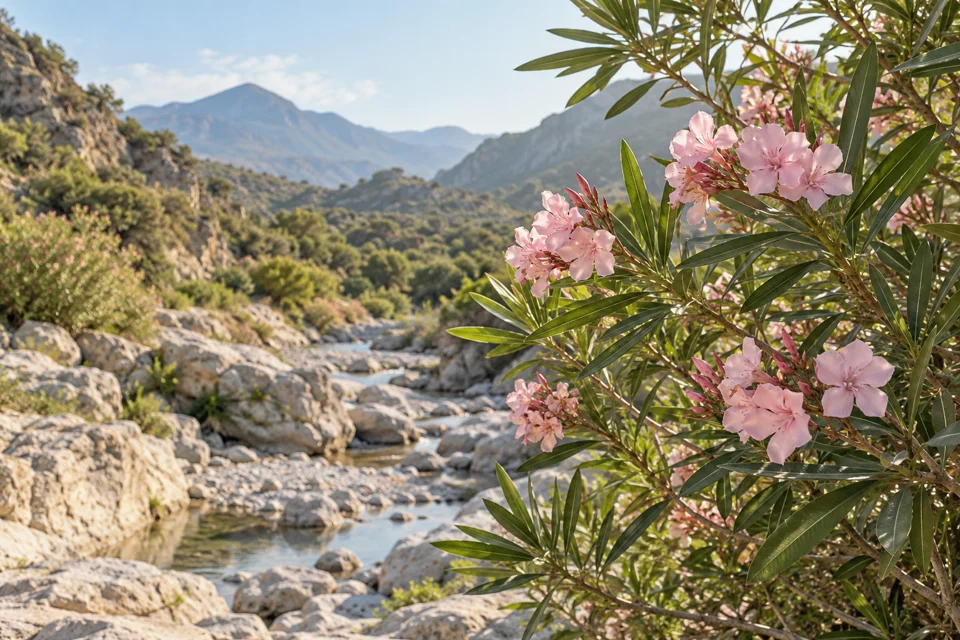
01 · FLOOR
Crete brings mountains, gorges, coast, farmland and small water areas close together. Therefore, the Natural History Museum of Crete presents biodiversity through ecosystems, not just as an addition of species. An animal or plant gets meaning because of the conditions in which it lives and the relationships it maintains there.
Use this section in two directions. Start with a habitat and find out which species can belong to it, or first find a species and then read about its environment. A profile does not prove that the species is present at every indicated location. Time, season and the right conditions determine what is detectable during a visit.
02 · FLOOR
Endemic means that a species or subspecies is naturally limited to a specific area. That area can be Crete, but also a wider region. Indigenous does not mean automatic endemic. A plant can grow naturally on Crete and elsewhere. A species brought by humans has a different history.
Always read which area and taxonomic level are meant. A subspecies can be local while the species as a whole has a much wider distribution area. A Dutch or scientific name with a cratenzic form is not in itself evidence. In the species guides that scope is explicitly indicated, with space for name changes and scientific uncertainty.
03 · FLOOR
Low Mediterranean shrub vegetation is one of Crete's characteristic ecosystems. In summer, the landscape can be dry and light-eyed, while there is a lot of life between spiky bushes, stones and open ground. The image changes greatly when plants grow or bloom and small animals become more active.
Stay still in an existing safe place. Look not only at the largest animal, but also at shade under a shrub and movement right above the bottom. Wonder what a clearing for a plant or insect means. That is a personal viewing command; the precise vegetation name and species composition require more botanical knowledge than one quick photo.
04 · FLOOR
The protected areas of Crete include various forest and shrub landscapes. The regional Natura guide mentions kermeseik, pine, cypress and maple vegetation. Tree height and density vary by terrain, climate and management. It is not an all-round green deck.
Note transitions. Where does open shrubland turn into a closed crown layer and what changes to light, wind and litter? A small difference can result in a different micro environment. Use the plant guide to learn some names and then find reliable local explanations for a specific area. Not every low-lying tree is a shrub species; growth mode and environment work together.
05 · FLOOR
On the Nida plateau, the NHMC describes, among other things, the endemic plant Polygonumidaeum. Such local examples reveal how a high landscape can have its own plant stories. Moreover, a flat plateau cannot be seen separately from the surrounding slopes, subsoil and the use by humans and cattle.
Look for growth close to the bottom, sheltered crevices and differences between grazed and less accessible pieces. Do not draw any conclusions about an entire species on the basis of one specimen. A mountain visit requires an appropriate route and conditions; this guide calls habitats and does not provide any guarantee of access or hiking instruction for high altitude grounds.
06 · FLOOR
In the west, Samaria's management unit connects the national park with a much larger network of protected areas. A gap includes several places: wall, soil, shade, water and higher edges. A visit photo usually shows only a small part of that spatial cohesion.
Use a rock wall as a comparison of conditions. Where does sun come, where does shade remain and where is vegetation possible? Look with binoculars and do not go to nests or plants on hard-to-reach ridges. Want to see a detail better is no reason to leave a route. The species overview helps especially to observe more focused from a suitable place.
07 · FLOOR
WWF Greece has studied island wetlands and draws attention to their value and vulnerability. In Crete, small swamps, estuaries, springs and seasonal water are also part of the natural story. A modest water site can be an important contrast with a dry environment.
Observe from an existing access or bank spot. See how reeds, open water, mud and shore bushes are next to each other and which animal uses a particular part. A heron and a frog use the same water in a different way. Do not walk into a lake to take a picture and do not move stones or aquatic plants for a better picture.
08 · FLOOR
On the route between Europe and Africa, Crete is an important place for migrating birds. The regional nature guide mentions resting places and a variety of coastal areas, wetlands and surrounding islands. A bird you can see can be a breeding bird, winter guest or temporary passerby.
Therefore, always record the date next to the species name. Also see what the animal does: resting, hunting, eating or flying through a group. Compare observations from different seasons before you call a place "bird arm'. The presence of a rare guest is never guaranteed. An ordinary bird that you get to know well can give more information than an unconfirmed rarity.
09 · FLOOR
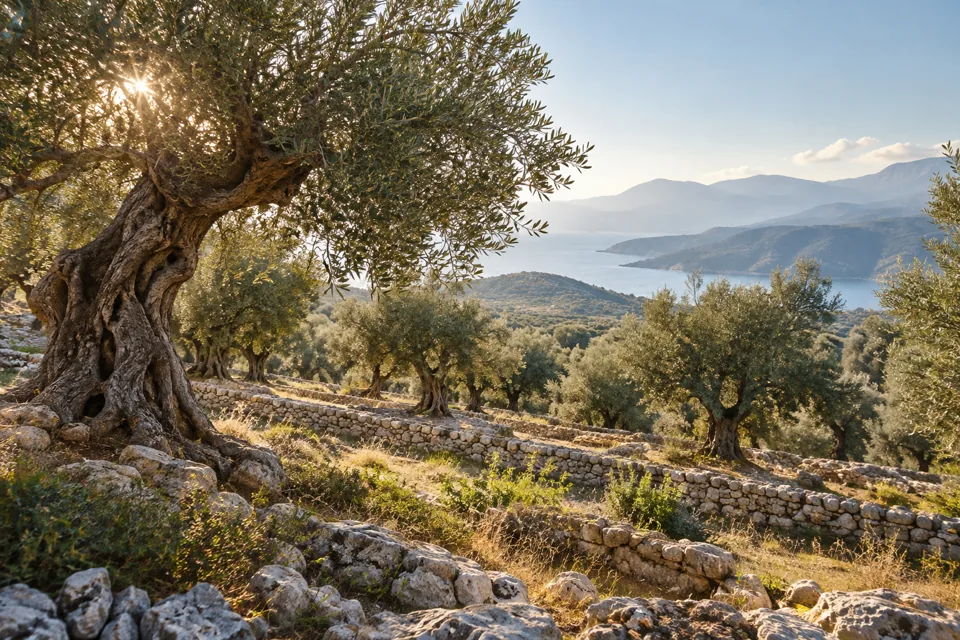
Olive oil trails connect orchards, mills and villages. This also makes it clear that part of the Cretan landscape is cultural land. An olive tree has a biological life cycle, while its location, pruning and harvest are linked to human work. In the nature department we keep these two sides visible.
Our viewing assignment is to describe three layers in one orchard: the crown, the soil and the edge. Which plants or animals do you see where? Ask permission before entering private soil and do not touch propagating material. The extensive olive and oleander guide shows how to connect a separate plant to such a larger landscape.
10 · FLOOR
A beach is part of a coastal system. Seagrass residues can accumulate on the coast and are related to the functioning and management of beaches and dunes, as the HCMR project POSBEMED investigates. A dark strip of washed-up material is therefore not automatic waste or a sign of dirty water.
Look at the transition from waterline to higher sands and vegetation. Leave plants and washed up natural material and follow the local directions. A sea lily is a plant at a specific growing place, no decoration to take away. Compare photo lily remotely with the plant profile; an AI illustration in this guide is no proof of its own determination.
11 · FLOOR
Vai in East Crete is known for its Cretan date palm, Phoenix theophrasti. The palms landscape is part of the larger natural and heritage story of the region around Sitia. Its species name does not mean that the plant is exclusively present in Crete; the flora guide gives the dispersal nuance.
Look at the forest as more than a photogenic crown. Look at young foothills, the ratio between stems and undergrowth and the place of water in the landscape. Compare this to a planted palm at a hotel. The same general growth form can belong to different species and very different environments. Stay within the accessible areas of the area.
12 · FLOOR
The Hellenic Centre for Marine Research investigates the Cretan sea area with measurements and repeated research trips. The water surface shows only a small part of that ecosystem. Sea creatures, sea grass, plankton and conditions such as temperature and flow are part of the story.
From the coast you can also ask specific questions: is the bottom sandy or rocky, where does natural material lie and what animals use the transition between land and sea? A boat trip or snorkeling moment is no guarantee of meeting with a turtle or dolphin. Keep your perception and the expectation that an excursion creates separate.
13 · FLOOR
ARCHELON monitors and protects the reproduction of Caretta caretta, including Chania, Rethymno and Messara. At the same time, a beach that is a recreational area during the day can be a nesting location, making careful cooperation between visitors, residents, businesses and nature conservationists important.
Keep your distance from nests and animals and follow the organization's instructions on site. Do not use flashlight in animals and do not light up nest protection. Carrying a young turtle to sea itself is not an ordinary visitor activity; leave help and assessment to the protectors involved. An information point can give more insight than an attempt to photograph an animal up close.
14 · FLOOR
The research on vertebrates at the NHMC includes more than the most famous animals on the island. A mammal can occur without being easy to see: night activity, shyness and a small distribution area affect the chance of a meeting. A museum collection is not a list of animals that now live freely in any place.
For this reason, read the explanatory notes on a species profile. A trace observation is different from an animal seen. Name an animal only if the characteristics justify it and otherwise keep a description. The overview chooses a reliable question over a spectacular but unconfirmed observation.
15 · FLOOR
The NHMC investigates the spread and kinship of species on Crete and other Aegean islands. A lot of biodiversity is small. A butterfly stands out, but beetles, spiders and soil life are also parts of the ecosystem. Some groups are difficult for a visitor to identify at species level.
Choose a non-distorting observation: a flower, a wall or a leaf that is already in sight. Do not turn stones for a photo and do not move an animal to a more beautiful background. In case of insufficient characteristics, we keep the group name in the guide or in a travel note. That is more accurate than giving each picture of a cicade a known species name.
16 · FLOOR
LIFE GRECABAT connects research to bats with management of caves and other cavefauna. Caves are not empty spaces: they can be resting or breeding places and host small animals with very limited distribution. Light, sound and entry can change the conditions.
Stay with official visits and follow fences. Do not use a cave as a location to light up or view sleeping animals. An information panel or museum visit can make invisible life accessible without disturbing a place to stay. The field guide describes groups and species, but does not publish clues to vulnerable resting places.
17 · FLOOR
The Natural History Museum of Crete also shows the fauna from earlier periods, including dwarf mommies. Fossils reveal that the island did not always contain the same species as today. A prehistoric animal in an exhibition is not part of the current species list.
In a travel story, keep three times apart: the rocks, the fossils and the life you see today. Ask a museum object for a location and dating. A model helps in the representation of a lost animal, while the fossil itself is a different type of evidence. That difference is consistent with the way this guide also distinguishes AI images and observations.
18 · FLOOR
NECCA describes poisoned bait as a serious threat to wild animals, including scavengers. A danger can also affect other animals via a cadaver. Nature protection is therefore not only about identifying a beautiful area, but also about reducing pressure and following changes.
As a visitor, you can stay on the accessible path, do not feed animals and respect local measures. Do not touch a suspected poisoned animal or suspicious bait and report the location to the area manager. An exact assessment requires experts. Keep your sightings above all place and time; do not bring material to an information point yourself.
19 · FLOOR
An inventory such as the WWF wetland map connects names to concrete areas. Such a source helps to create a loose impression, but does not replace actual perception. The map of a habitat and the evidence that a particular species was present there on a certain day are different types of information.
For your own note, date, location, behavior and multiple visible features are important. Do not make a definite species notification based on just an out of focus photo or preview on this site. Leave space for a group name and an open question. Do not share the precise location of vulnerable nests and residences in a travel story.
20 · FLOOR
The change of growth, flowering, drought, rain and bird migration changes what you can see in Crete. As a result, a spring observation is not easy to compare with an afternoon in summer. Also height, location and differences between years matter.
Use the seasonal window as orientation. The table shows processes to be careful and not a guaranteed flowering or visual calendar. For a next walk, choose one question: what change do I see in the same environment? A comparison of two ordinary moments can tell more about nature than a long list of species you just hoped to see.
Indicative processes to pay attention; no flowering forecast or guaranteed visual calendar. Location, altitude and weather of a year can make a lot of difference.
| Season | What are you looking at? | A custom viewing command |
|---|---|---|
| Spring | New growth and much bloom; bird movements may increase. | Find different growth forms and note flowers and leaves. |
| Summer | Drought becomes visible; water, shadow and time influence observations. | View from a suitable place the transition between sun and shadow. |
| Autumn | Rain can resume growth; harvest and bird migration give other accents. | Compare fruits, soil and bird behavior with an earlier visit. |
| Winter | Rest and activity exist side by side; altitude and weather determine a lot. | Notice evergreen leaves, water in the landscape and birds present. |
Sources consulted on October 17, 2026. The guide combines scientific and local natural resources with their own viewing assignments. The selection has been extended, but not a full list of Crete species. An AI illustration supports the story and is not suitable to assess a plant for edible or to identify a species with certainty. Dissemination, names and knowledge can change; the source per profile gives the context.