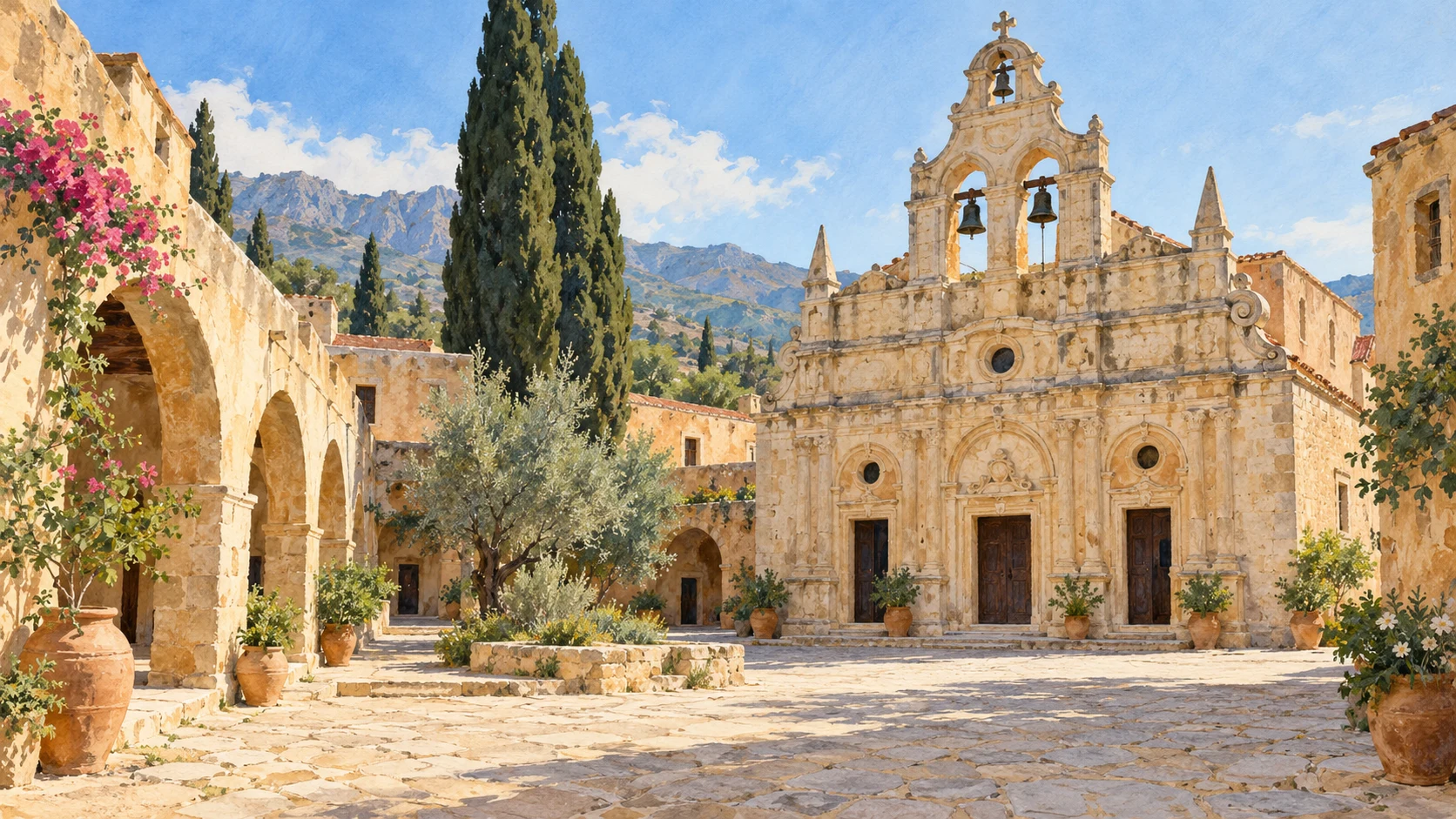
Arkadi, Toplou and Preveli: architecture, icons, living communities and the history that persists in buildings and memories.
AI-Illustration · artistic impression, no exact representation of landscape, history or species.
01 · CRETE
Arkadi · the facade and the memory of 1866
Μονή Αρκαδίου
Arkadi is located in the interior of Rethymno. The church façade shows the encounter between religious architecture in Crete and renaissance forms. The archaeological service describes a sixteenth-century building history with the involvement of the Kallergis family. Symmetry, openings and decorations give the façade its coherence.
First look at the whole and then one cut detail. Where does the façade rest and where is your gaze led up? The church is located in a monastery complex, with also practical spaces for a community. A beautiful façade is one part of a living environment.
In November 1866, the monastery became an important center of the rebellion against the Ottoman authority. During the siege, the gunpowder warehouse exploded; many of the people present were killed. The events received international resonance and remained an important part of the Cretan memory culture.
Give this history its own moment next to the architecture. Read on-site explanation and see how objects and later works of art pass the story. The visit is about both an event and the meaning that subsequent generations gave it.
Our proposal: first the church and the built space, then the memory of 1866, with a pause between them. Thus Arkadi remains more than a famous event or a photogenic facade.
Check opening, accessible parts and clothing instructions on the official website. Follow photo rules per room. A visitor entrance does not mean that all buildings or services are part of a tour. A combination with Margarites or Eleutherna can fit, but choose one supplement and give a meal time.
Toplou is located in the vicinity of Sitia and Palaikastro. The complex has a reinforced character, with buildings around a courtyard at different levels. Religious spaces, residence and defense are part of the same architecture. The older name Panagia Akrotiriani refers to the community dedicated to Mary.
The municipality of Sitia mentions Toplou in an Ottoman document from 1673 and connects the often given name statement with the Turkish word for cannon. Such a statement is a historical explanation of a source; the façade itself does not prove it.
Icons, manuscripts and liturgical objects show a different side of the fortified building. A monastery could also preserve knowledge and image culture. Note an inscription, gesture or material of an object and read the available explanation.
Agriculture and viticulture are also part of the history of the community. A product that you can taste connects buildings with land and daily work. Speak a production visit in advance where necessary. The gorge at Toplou is a separate walk and does not need to be an automatic part of a cultural visit.
An icon is a religious image with a function in prayer and worship. In a museum you can look closer, but the original environment of use has changed. Ask where and how an image was used.
Attitude, gesture, clothing, background and inscription help in recognition. Repeating is part of an image tradition; a familiar image can get meaning because of small differences. A painting is not a loosely decorative plane here.
Choose one work for which explanations are available. Read the explanation and look again: what details were missed? Respect rules for photography, light and distance. Slow looking often results in more results than photographing all works without a break.
Preveli is located on the south side of Rethymno. History includes the lower Kato Monastiri and the higher Piso Monastiri. The own architectural and historical pages make a distinction between these buildings and periods.
This distinction helps with your travel plan: the palm beach, the lower monastery and the active visitor point are not the same entrance. Check the exact location and current access. The landscape connection makes the area interesting, but is not a freely accessible visitor route everywhere.
The monastery's history also describes education and the contacts with the surroundings. The museum shows objects from a longer religious and cultural tradition. A monastery was dependent on villages, agriculture and the connections through the landscape.
Our proposal: a quiet visit to buildings and collection. Then choose the beach separately, depending on weather, access and energy. This way the community gets its own story and it not only becomes the background of a beach day.
After the Battle of Crete, people around Preveli and the monastery community helped left behind allied soldiers. Accommodation, information and escape were dependent on cooperation and local knowledge.
The Australian Ministry of Veterans Affairs describes the monument at Preveli, with representations of the abbot and an allied soldier. It connects a local place with memories in other countries. The sea in this story was a possible escape route.
Ask at a memorial place who stays outside the show: residents who shared food, knew paths or offered shelter. Thus, a famous war story becomes an opportunity to see the many forms of cooperation.
Byzantine refers to a long historical world and to art traditions that continue to work later. Orthodox churches and icons retain meaning under Venetian and Ottoman rule. Therefore, a period of administration and style do not always coincide.
Panagia Kera at Kritsa helps to understand the relationship between church space and mural painting. The Historic Museum of Crete offers a broader view of art and society. First, view a space, then an image and then place both on the timeline.
During a visit, consider the life of the community. Church, cells and workspaces have different functions and not everything is meant for visitors. Read clues for clothing and photography and leave room for prayer and daily work.
The map shows the island. Open a place separately to view the location; these are search links, not controlled walking or car routes. External maps ask internet.
Editorial edition · 21 October 2026. Visit proposals and exercises are their own effects. Check current access, transport and local conditions with the official administrator.