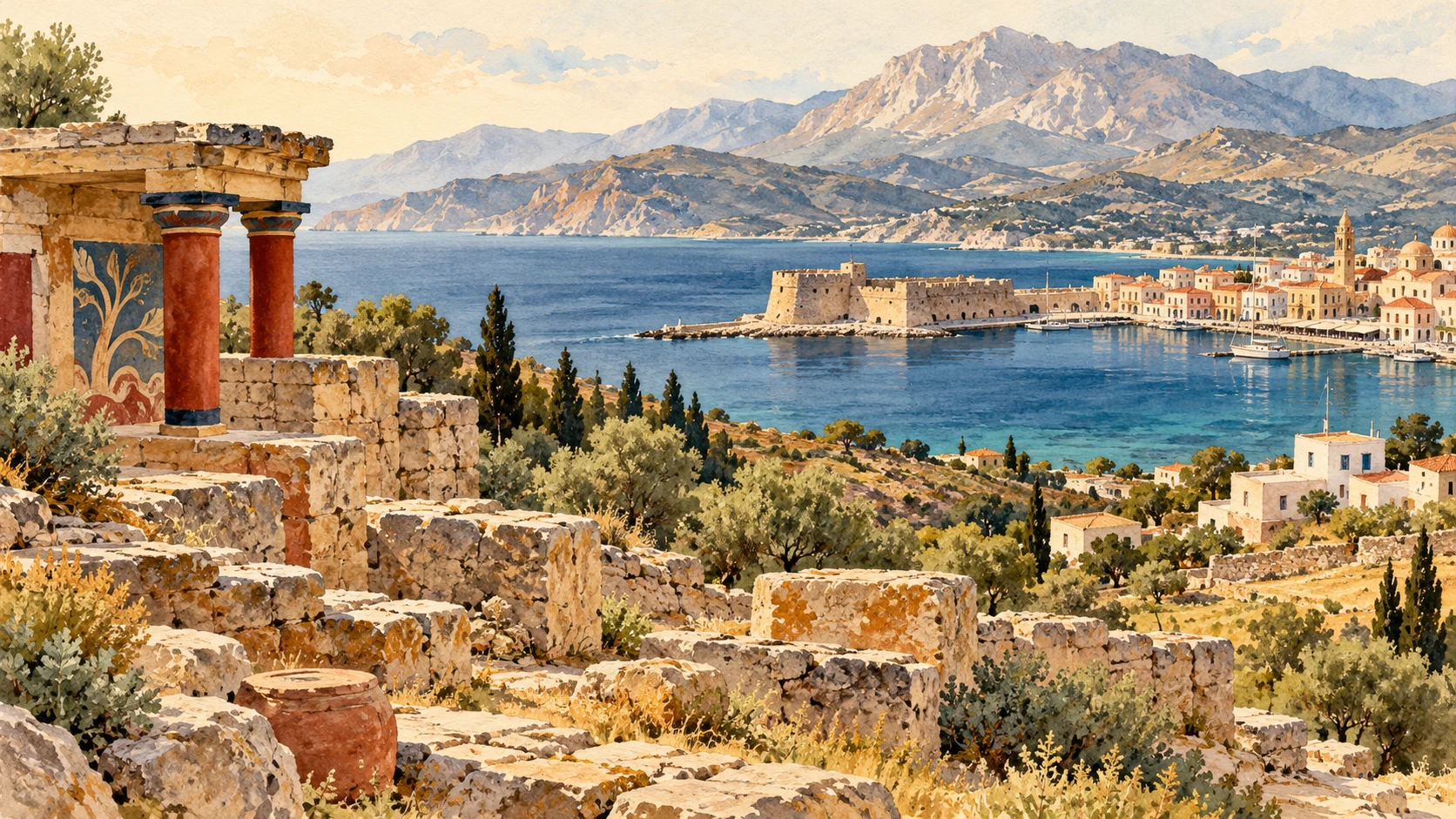
Fourteen historical windows, from early habitation to the island of today, with links to the stories behind the years.
AI-Illustration · artistic impression, no exact representation of landscape, history or species.
01 · CRETE
Before approximately 3000 BC.
Before the palaces
Long before Knossos was given monumental buildings, people lived on the hill and in other places in Crete. Agriculture, storage and houses form an older background than palace culture. Therefore, start with habitation and daily work, not with a mythological king.
See a tool or container in a museum. It makes a great concept concrete: what could be done with it and what labor asked it? The development to large centres was not a predetermined destination.
Crafts, exchanges and differences in organization form the background of the later palace centers. The word Minoan is a modern name, derived from Minos from the Greek story tradition.
Earthenware, metal and images point to skills and contacts. A loosely beautiful object tells no complete social history. The location, dating and comparison with other finds allow a well-founded interpretation.
Knossos, Phaistos, Malia and Zakros belong to a world of large centers. Interiors, storage, workshops and writing show different sides of organization. The periods include destruction and reconstruction; it is not one unchanging golden age.
Visit one complex carefully and compare it later with a second. Agreements help to see a network; differences in location and scale prevent all palaces from getting the same story.
In the later bronze age, Knossos is connected to Linear B, a script for an early form of Greek. Keep that phase distinct from the earlier Linear A. Tablets open a window on administration, not a full record of life.
The scriptural guide shows why signs, language and material raise various questions. A change in the palace organization does not mean that the whole island ceased to be inhabited.
The Roman conquest places Crete in a new political cohesion. Cities change and governance and economic contacts get other connections. The regional history of Archanes is called 67 BC as an anchor point.
Gortys can form a further entrance, with separate preparation of a visit. Think also of continuity: people continue to use land, move goods and modify buildings. A new ruler did not delete all local habits.
With the spread of Christianity, religious buildings and statues change the landscape. Crete belongs to the eastern Roman, later Byzantine mentioned world. Churches, commerce, crafts and local communities carry changes.
Ask for dating and reuse in a stone or relief. Material may be older than the building in which it was re-used. The museum collections help to distinguish these different layers of time.
Crete comes under Arabic rule in the ninth century. Chandax is an important center in the history of the present Heraklion. In 961, the Byzantine recapture follows.
A city has different names in different languages and periods. An old map can thus name the same place differently. Look at the relationship between port, defense and hinterland to understand the importance of the place.
After 1204, Venice gradually gained power in Crete; the establishment and control took place in phases. Ports, walls and urban institutions changed, while Orthodox traditions continued to exist and developed.
Kornaros and icons painting offer entrances other than war and administration. A Venetian facade, orthodox church and Greek story can belong to the same historical society. However, place individual makers in their own time.
The conquest begins in 1645. With the fall of Candia, the present Heraklion, in 1669 the Venetian government ends over most of Crete. Some fortified support points remain outside that control for longer. So one year for the whole island is a simplification.
The subsequent society has Christian and Islamic inhabitants and changing relationships. Take that longer society alongside the story of uprisings and wars.
The nineteenth century has revolts and a growing desire for association with Greece. Arkadi in 1866 becomes an important reminder point. The tragic end of the siege is echoed internationally.
A memorial site tells both what happened and how later generations give it meaning. Read objects, testimonies and monuments with attention to the kind of source. The monastery guide connects the event with the place.
At the end of the nineteenth century, an autonomous Cretan state will be established under international protection. In 1913 the association with Greece will be formally completed. Conflicts, diplomacy and political choices determine the way to it.
A flag, seal or document makes a change of administration visible. Which symbols have been chosen, what is appointed and who signs? Thus, a year takes a concrete form.
The German air-landing attack of May 1941 leads to the Battle of Crete. Then, occupation, resistance and severe consequences for civilians. Memories of loss, help and flight are part of the landscape in many places.
Preveli offers an entrance through help to left behind allied military. The Historical Museum places the war in a broader context. Connect one local place to that larger history.
Reconstruction, migration, urban growth and tourism change Crete. At the same time, agriculture, music and village networks continue to renew themselves. Today is not a frozen remnant of the past.
Leave an old photo next to a current street. What has been rebuilt, what function has disappeared and what action still exists? The village portraits and the seasonal guide connect this timeline to daily life.
Since 2025, Knossos, Phaistos, Malia, Zakros, Zominthos and Kydonia have formed the UNESCO World Heritage Minoan Palatial Centres. The registration highlights the network of sites.
A heritage label is a contemporary choice to protect and explain old material. Research and restoration remain part of the story. The Knossos guide shows why the distinction between original remains and later reconstructions is important.
Periods are tools. Political governance, art and daily life do not all change at the same time. Use a period as an entrance and then deepen in one place or subject.
Editorial edition · 21 October 2026. Visit proposals and exercises are their own effects. Check current access, transport and local conditions with the official administrator.