HERAKLION · ARCHAEOLOGY · A PLACE WITH MANY LAYERS OF TIME
Knossos · between palace, myth and excavation
An extensive visit to the most famous Minoan center: from courtyards and clay tablets to fresco pavilions, the labyrinth and modern reconstructions.
Κνωσός · Μίνως · Αριάδνη
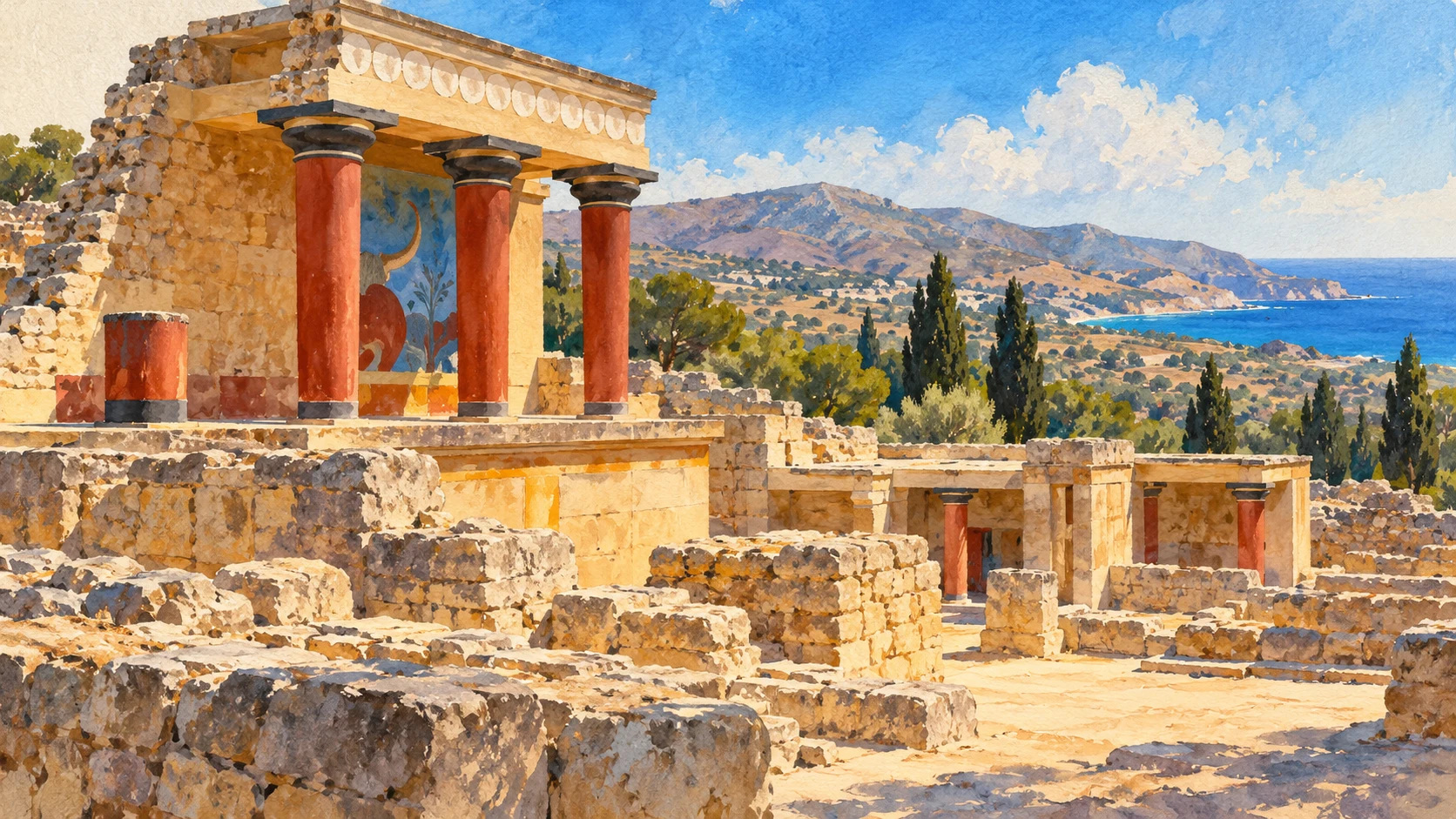
AI illustration · artistic impression, no photo, exact map or scientific reconstruction.
Location
At Heraklion · hill Kephala
First Palace
Approximately 2000 BC 1900 BC.
World Heritage
Since 2025 · six Minoan centers
Combine with
Archaeological Museum Heraklion
01 · KNOSSOS
Knossos is more than a palace
Knossos is located near Heraklion, on the hill of Kephala. The large ruin is the most famous part of a much larger antique place. Living and using cover several periods, from the Neolithic. So you don't visit a building that was created at one time and then remained unchanged.
The word palace helps to understand the scale and meaning, but easily evokes the image of only a royal home. Knossos was also connected to governance, storage, production and religious activities. The complex is part of a network of Minoan centers in Crete. That broader view helps to read the ruins as an organized living environment.
Our suggestion for the first few minutes: find the connection between open spaces and buildings. Note the differences in altitude and the way passages determine a route. Save the most famous names for afterwards. First, understand where you stand makes the stories about the individual spaces much clearer.
A settlement already existed in front of the Palace buildings. Around 2000 BC the first palace was built. After a destruction around 1700 BC a larger complex was built. This new palace determines an important part of the image that we connect with Minoan Knossos.
Later history has been re-destruct, repair, and changes in use. The precise dating and explanation of individual events are the subject of investigation. A simple timeline is useful to organize periods, but does not automatically explain every wall or find. Moreover, the end of a palace phase does not mean that the whole place ceased to exist immediately.
An earthquake, fire or administrative change leaves different kinds of traces. Therefore, a ruin is not a stationary end impression of one disaster. Look at the question of which building phases and functions are recognizable in one place. This avoids the expectation that everything that is next to each other was used at the same time.
The palace complex is organized around a large central courtyard. Hellenic Heritage describes four wings with a variety of spaces: storage, workshops, ceremonial zones and accommodation spaces. That combination explains why the building feels so large and complex.
Use the courtyard as an imaginary anchor during your visit. On which side is a space? How open or closed is the approach? What changes when you go from a courtyard to a passageway or stairs? Such questions make a map readable without having to remember every name.
Our suggestion: choose a few carefully explained parts instead of finishing the site as soon as possible. A guide or information panel can explain which function is reasonably certain and which name comes from the excavation history. Always follow the available visitor route; the logic of an old building and the current accessible route do not coincide entirely.
A large center needs more than representative rooms. Food, materials, people and administration need to be coordinated. The storage rooms and workshops described at Knossos make that practical side visible. They remind you that monumental architecture rests on daily work.
Ask a storage space what you need to collect and redistribute goods: space, containers, access and a way to remember numbers or obligations. Not every detail of that organization can be read from one building. Objects, scripts and links with other sites complement the image.
The most impressive thought is that the palace was also an information system. What needed to be kept, who could be included and how was an assignment passed on? From those questions are given a relationship. Next time you see a large barrel in a museum, it is not only a beautiful object, but also a part of labor and management.
The municipal description indicates light shafts, multiple door openings and water and drainage systems. Such facilities make it clear that builders thought about the usability of a complex with different levels and functions. Architecture here is more than a decorative facade.
A light shaft brings daylight into parts of a building that would otherwise lie deep inside. Several openings can change the relationship between spaces. Water must be supplied or discharged along a route that fits height and use. Look at such elements as answers to concrete spatial problems.
Be careful with modern superlatives such as the world's first plumbing or the very first air conditioning. Such claims require much more evidence than one impressive installation. For a good visit, it is more interesting to understand the problem that solved a building element. This question connects old technology with a recognizable human need: light, movement space and a building that works in everyday life.
The throne room: a famous name, questions about use
The throne room is one of the most recognizable parts of Knossos. The official descriptions call the stone seat, benches and the nearby deeper basin. The departure brings the visitor quickly to thoughts about power, reception and ritual.
Yet the name of a space is not a complete explanation of what happened in every period. A modern visitor easily thinks of a king who makes daily decisions. Archaeological interpretation requires the coherence of objects, images, construction phases and comparison with other spaces. Keep that step of perception to explanation visible.
Our suggestion: first describe the location of the seat and the way people could stand or sit in the room. Then read the explanation of possible functions. Thus, the room will not become a place where you just take the well-known photo, but a reason to think about how architecture can show authority.
The Knossos bull jumper show is one of the most famous sculptures of Minoan art. Heraklion's museum describes it as the best preserved of multiple paintings with the same subject from the east wing of the palace. The tense line of the animal and the positions of the human figures give the performance its energy.
Look at the painting as a carefully constructed image, not as a photographic account of one event. The relationship between ritual, sport and performance requires explanation and comparison. Also, the way fragments are combined into a larger whole is part of the story of what you see now.
The Prince of the Lilies and the Dolphin Fresco offer other entrances: clothing and human presentation, or the imagination of the sea. The museum texts help to distinguish subject and material. Choose one work and read the caption slowly. Which parts have been preserved, what has been completed and what remains uncertain? Those questions make the color world richer, even when not every detail can be definitively explained.
Knossos is also connected to Linear B. This script was deciphered in the 20th century and it turned out to be an early form of Greek. The history of this decryption shows how strings, patterns and language equations opened a new source over the bronze age.
The clay tablets are mainly administrative documents. They give a different kind of view than a myth or a fresco: they are recorded and ordered. The British School at Athens shows in an educational demonstration how such tablets were made. This also makes the material itself understandable, as a usable surface for a particular task.
Do not confuse Linear B with Linear A. The names are similar, but the state of deciphering and the language questions differ. Our separate guide on Phaistos and the old scripts goes deeper into that. Take the time for a museum tablet to ask why this information was worth recording.
In the Greek tradition of storytelling, Knossos is the world of King Minos and the labyrinth of the Minotaur. Theseus enters the maze and receives help from Ariadne, whose wire makes the way back possible. Daedalus and Icarus are also connected to the circle of stories around Minos.
These stories have a great cultural significance and help explain why the place is so powerful to the imagination. They are not an excavation report. A complex map does not prove that half a human, half an animal has lived there; a bull's image does not confirm every part of a later story.
You can use both types of looking side by side. First read the myth about fear, power, help and escape. Then view the complex as material history with your own questions and proofs. For your travel book: what does Ariadne's thread do in the story, and what tool gives you hold on to an unknown place?
Kalokairinos, Evans and the modern image of Knossos
Minos Kalokairinos conducted the first excavations on the hill in 1878. Arthur Evans started large-scale systematic research in 1900. The history of the British School at Athens also shows that Knossos remained an active research site afterward, with buildings, collections and researchers around the site.
The famous image of Knossos is strongly shaped by Evans' reconstructions. They make building volumes and colour imaginable, but also bring the interpretations of the early twentieth century into the visible monument. The red columns are therefore simultaneously a distinctive sign and an incentive to look at the modern history of archaeology.
In a reconstructed part, ask not only what it was like before, but also what the present performance is based on. What remains were there, what choices were made and how is it explained? A reconstruction can be educational as long as it remains clear that it is a reasoned intervention. The AI illustration of this guide is another kind of image: an artistic impression that does not add new archaeological knowledge.
Since 2025, Knossos has been part of the UNESCO World Heritage Minoan Palatial Centres. It is a joint registration of six sites: Knossos, Phaistos, Malia, Zakros, Zominthos and Kydonia. Its meaning lies in the network and cohesion, not only in the most famous palace.
UNESCO stresses governance, architecture, writing, exchange and lasting cultural influence. At Knossos, the organisation also identifies the challenge of the extensive reconstructions of the early twentieth century. The distinction between authentic remains and subsequent additions is therefore part of the heritage care itself.
This gives a nice direction for a further trip: compare Knossos with one other center. Which questions do you again recognize and what differences do you see in landscape, scale and presentation? You don't need to visit all six locations in one holiday to understand that the Minoan world was larger than one complex.
Combine the terrain with the Heraklion Archaeological Museum where possible. At the site you can experience space, terrain and coherence; in the museum you can see objects and fresco fragments up close. A well-read museum object can then clarify a ruin, and vice versa.
Check the official Hellenic Heritage page for opening, ticket conditions and the current visitor route. Look for access and opening times for the museum separately. Do not rely on an old combined ticket or a price that stays in a travel blog. Ask for the complete route if stairs or uneven subsurface are a restriction.
Our proposal: choose a cooler, suitable period of the day for the outdoor area, with drinking water, sun protection and shoes with grip. Keep space for a real break between terrain and museum. Children can choose three assignments: find an open space, a place for storage and an image with an animal. That makes a large complex easy to handle without being a competition to see everything.
Consulted on 21 October 2026. Actual background is based on the sources below. Visiting proposals and viewing questions are editorial suggestions. The AI illustration is an artistic interpretation and does not provide evidence about terrain, architecture or visible sky at any given date. Names and functions of rooms include archaeological interpretation. Dates are appropriate approaches where appropriate. Myths are not presented as historical facts.