01 · READ & WATCH
Crete before and during the palaces
An excavation is not a stopped moment. Under a wall older floors can lie, above later interventions. The wide Minoan development is placed by UNESCO approximately between 2800 and 1100 BC; the registered palace centers are within a narrower range from about 1900 BC. This does not mean that all buildings were erected simultaneously or remained in use for the same length of time.
The term Minoan is a modern name that refers to the mythical Minos. He gives archaeologists a workable name for a connection of material and development, but does not tell what every resident called himself. Our classification in periods is also a tool to organize changes.
Therefore, read a dating as a question about the object: is it the first habitation of a site, the construction of a palace, a layer of destruction or the later use of the same place? A single date for a tourist board can unintentionally compress the different layers.
Source and Continue Reading → · Own editorial explanation; source, interpretation and cooking or learning proposal remain distinct.
02 · READ & WATCH
A palace is more than a king's house
The word "paal" quickly reminds us of a monarch and his private quarters. However, the Cretezo Palace Centres were also places of storage, crafts, administration and ritual. Binnenhoven connected different spaces; large storage vessels and workshops make it visible that much more happened than living.
A room with a stone seat doesn't automatically tell who was sitting or what power that person had. Archaeologists combine architecture, traces of use, objects and their location. Moreover, the function of a room can change. The well-known names of departures are often interpretations that help guide visitors, not labels that were on the original door.
A good viewing exercise: choose a space and find three directions for the function. Are there storage facilities, a special access, work material or traces of repeated actions? Then consider what other explanation might have the same remnants. This gives uncertainty a concrete form instead of just a general reservation.
Source and Continue Reading → · Own editorial explanation; source, interpretation and cooking or learning proposal remain distinct.
03 · READ & WATCH
Storage vessels, meals and work
According to the Ashmolean, the habitation of Knossos reaches back to about 7000 BC. Animal remains, charred grains and pottery give a different access to the past than an impressive palace facade. A container or cooking pot can tell something about daily activities that do not fit in a large story about kings.
Pithoi are large storage vessels. The combination of barrels, remains and administration helps researchers to ask questions about food, supplies and labor. A tablet with goods is not a cookbook; an animal bone is not a complete menu. Different types of evidence complement each other, but does not answer exactly the same question.
For a comparison, put a contemporary Cretan meal next to such finds. You can recognize similarities in raw materials without claiming that Dakos or a modern pie was already made exactly like this. The landscape can offer long-lasting possibilities, while recipes, trade and eating habits change.
Source and Continue Reading → · Own editorial explanation; source, interpretation and cooking or learning proposal remain distinct.
04 · READ & WATCH
Linear A, Linear B and the limits of reading
Recognizing a script is something other than understanding the language. Linear A is not yet convincingly deciphered. Linear B found that the characters represent an early form of Greek. It is a logo-syllabic script: a combination of characters for syllables and characters with other administrative functions, not an old copy of the current Greek alphabet.
Michael Ventris achieved the decisive breakthrough in 1952, building on earlier research, including that of Alice Kober and Emmett Bennett. Decryption here is pattern research: recurring strings, inflections, possible place names and the comparison of hypotheses. It is not intuitive guessing based on a sign that resembles a modern letter.
The administrative nature of many tablets determines what they show: products, numbers and organisation are better represented than personal conversations or stories. This makes the data valuable and selective. Therefore, this guide does not offer a translator for Linear A and does not represent modern Greek language lessons as a direct reading instruction for both scripts.
Source and Continue Reading → · Own editorial explanation; source, interpretation and cooking or learning proposal remain distinct.
05 · READ & WATCH
Evans: Make visible is also choose
Arthur Evans worked in Knossos between 1900 and 1931. The Ashmolean places the use of the palace about between 1900 and 1350 BC. The sight that visitors now know is partly formed by interventions in the twentieth century. Some disappeared wooden columns received concrete replacements; fragments of fresco pictorial images were supplemented to larger images.
These interventions make architecture understandable and at the same time put a strong interpretation in the landscape. In parts such as the northern bastion, details are uncertain. A coloured wall or complete figure can therefore seem more convincing than the material provided justifies. A smooth digital model can also make such choices invisible.
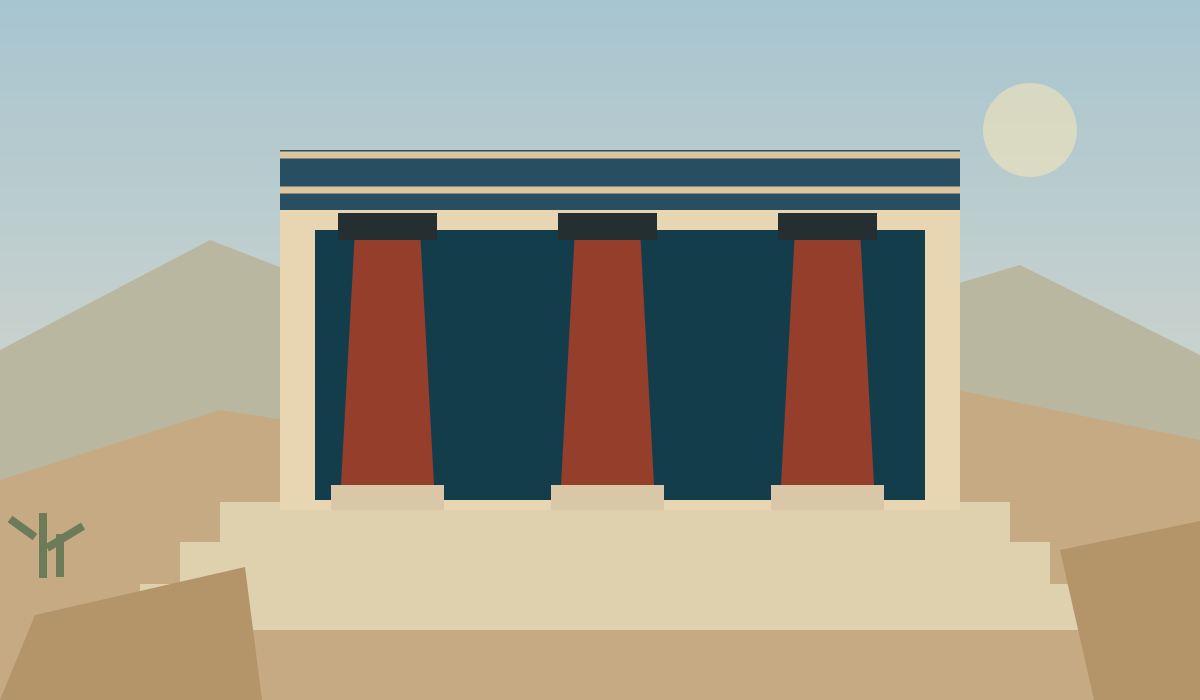
Use three questions: what has been saved, what has been added modernly and on which instructions is the addition? A reconstruction can be careful and educational, but remains a proposal. The opening silt of this guide is therefore expressly an editorial image, not a map or picture of the palace as it once was.
Source and Continue Reading → · Own editorial explanation; source, interpretation and cooking or learning proposal remain distinct.
06 · READ & WATCH
The labyrinth: story and find side by side
The story about Minos, the Minotaur, Theseus and Ariadne gives Knossos a place in the imagination. It asks questions about power, violence, sacrifice and escape. A complex building can evoke the image of a labyrinth, but does not prove a historical monster or literally recovered wire.
A myth is not a failed dig-up report either. She has her own storytellers, variants and meanings. Whoever puts her only along the measuring bar of factual correctness misses what the story does; whoever uses her directly as history makes the sources disappear. You can read both carefully by naming the kind of question.
First read the mythical route in the accompanying guide. Then look again at a courtyard, an entrance or an image of a bull. Describe what you actually see before adding the known names. That small delay makes the meeting with Knossos richer.
Source and Continue Reading → · Own editorial explanation; source, interpretation and cooking or learning proposal remain distinct.