10 chapters · Greek words, practical explanations and connected reading routes.
01 · FLOOR
One morning starts at the oven
A bakery is a small map of local eating habits. Bread for home, something for the road, a hearty piece for later: not everything behind the same display case has the same role. Look at shape and structure and ask for the filling in an unknown product.
Make your first visit a simple trial. Choose a piece of bread and one pie, share it and compare what is still cold. You will discover more than when you only take the largest or most decorated product.
02 · FLOOR
Psomi, koulouri and paximadi
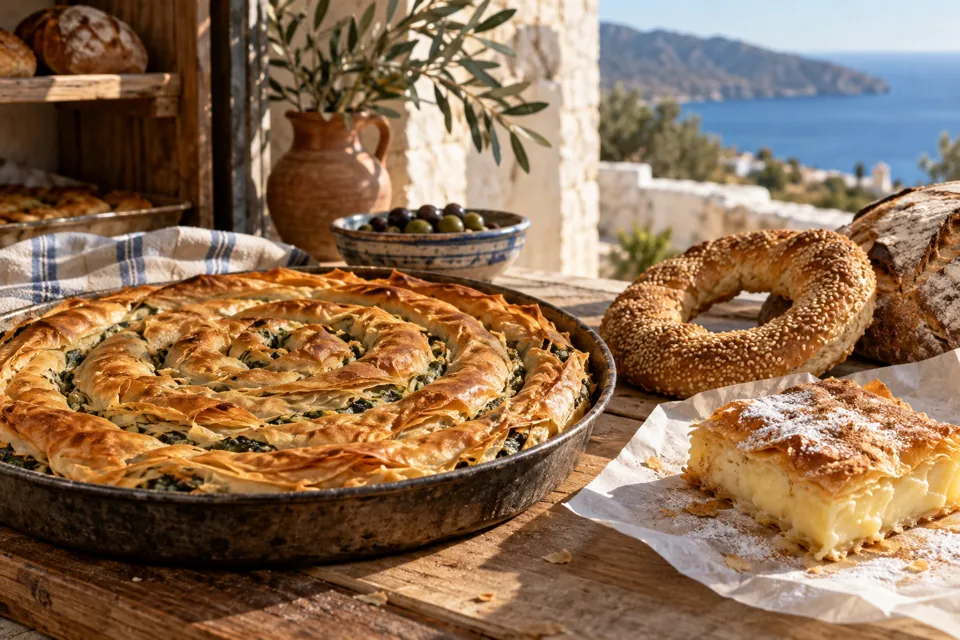
Psomi is the general word for bread. Koulouri can be found as a sesame ring, while names and shapes may vary per region. Paximadi is dry, hard bread or biscuit that has its own role in the Cretan cuisine, including in roofos.
Don't just pay attention to the name. A soft ring and a dry barley ring ask for a different way of eating. Ask if something is eaten directly or needs a little moisture first. Judging a dry russle as if it is a fresh bun misses the purpose of the product.
03 · FLOOR
Why dry rusks come back to life
At the roofos, moisture comes from tomato and sometimes a small amount of water together with oil and cheese on the rusks. The art is a pleasant transition from hard to edible, without making it a mushy soil. Therefore, start with little moisture.
Make two small versions and try after different waiting times. One rusks absorb moisture faster than the other. Note what you did so you don't have to gamble again next time. The existing roof os recipe in the guide is a good starting point.
04 · FLOOR
Filo is a system of layers
Thin dough layers and a little fat together create a layered exterior. Moist in the filling, thickness of the dough and baking time determine whether the bottom becomes firm. A beautiful top does not guarantee a well baked bottom.
Keep loose sheets covered as indicated in the packaging. Work with a non-wet filling and a suitable baking tin. Apply oil or butter thin; a puddle of fat does not dry a too moist filling.
05 · FLOOR
Spanakopita and hortopita
Spanakopita revolves around spinach; hortopita revolves around a wider filling of leafy vegetables and herbs. Recipes differ in cheese, egg, dough and herbation. Dill, parsley and mint can give the filling a completely different character.
Cut the vegetables fine enough to cut a pleasant piece and leave out excess moisture. If you have a warm pre-baked filling, cooling is useful before building the pie. Do not use any gambling in unknown wild plants: choose familiar, edible vegetables purchased.
06 · FLOOR
Bougatsa and the demand for the filling
Bougatsa often evokes the image of sweet cream filling with icing sugar and cinnamon, but the name alone does not always tell exactly what a baker sells. Ask if a piece of cream or cheese is filled and if it is sweet or savoury.
Do not cut a hot piece directly into very small portions when the filling is still loose. Let it be made short. A little cinnamon can be added to the table; so you can taste the buttery dough layers on your own first.
07 · FLOOR
A first own rustic dough
Own practice dough for a small savoury pie: mix 250 g flour, 1⁄2 teaspoon of salt, 2 tablespoons of olive oil and about 120 .140 ml of water. Start with the least water, knead to a smooth dough and let cover rest for about 30 minutes. This is a thicker practice dough, no promise of factory thin filo.
Distribute in two parts and roll out on a slightly flowered worktop. Use a suitable, non-wet pre-prepared filling and follow a full pastiir recipe before baking. The exercise is in feel: smooth enough to roll, not so wet that it sticks everywhere.
08 · FLOOR
The soil deserves attention
Bake a pie not only on the colour of the top. Choose the oven stand, temperature and baking time of the recipe and check the bottom where you can. A metal baking shape behaves differently than a thick ceramic bowl.
Allow a fried pie to cool in a way where the soil is not in condensate for a long time. For reheating, a oven often gives a more pleasant crust than a sealed tray in the microwave. For cooling and storage, follow the ingredients and food safety advice.
09 · FLOOR
Four words on the counter
Ψωμί Oh, uh, uh, uh, uh, uh, uh, uh, uh, uh, uh, uh, uh, uh, uh, uh, uh, uh, uh, uh, uh, uh, uh, uh, uh, uh, uh, uh, uh, uh, uh, bread. Φούρνος Oven oven, and in daily use also the bakery. Τυρόπιτα Oh, uh, cheese pie. Σπανακόπιτα "Thank you. Τι γέμιση έχει; What filling does it have?
For taking: Για το σπίτι, παρακαλώFor home use, please. If you have allergies, always ask for the ingredients; a savoury filling may contain cheese, egg or nuts. The form of a pie is not a reliable ingredient list.
10 · FLOOR
A small baker's table
Place three different structures next to each other: a piece of fresh bread, a little paximadi with tomato and a small piece of pie. Add olive oil, water and cheese. First taste separately and then combined.
Go to the cheese guide to choose a filling, to herbs for the green accent and to Sweet Greece for syrup and pastries. A pastry technique is recognizable when you see it in different dishes.