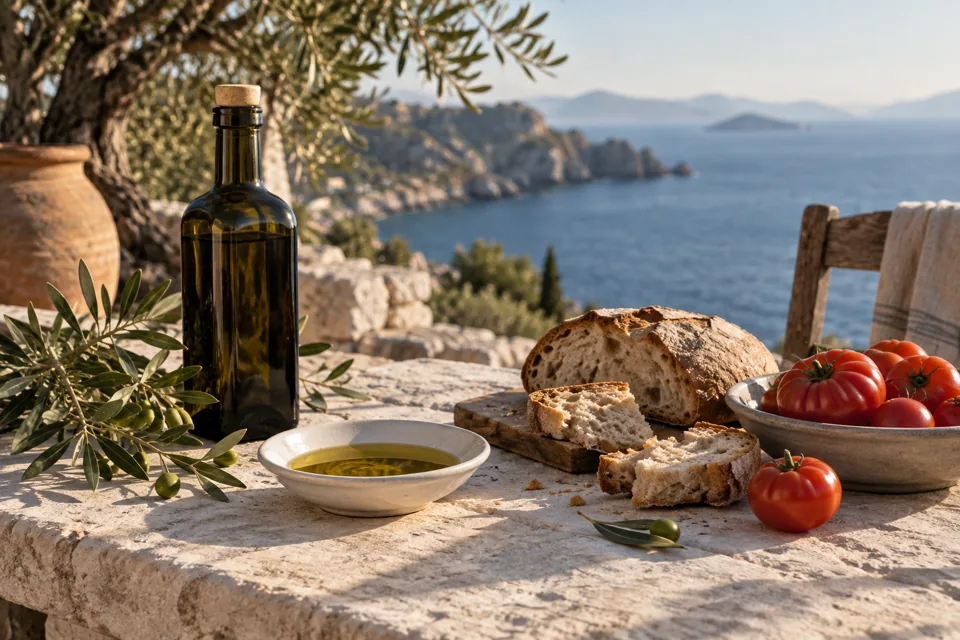
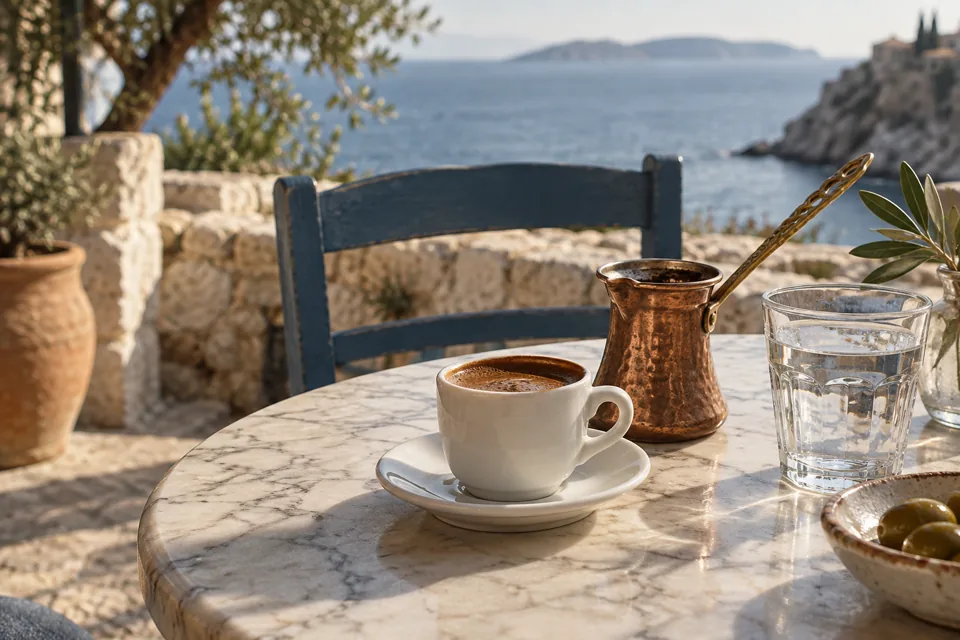
A contemporary table as the beginning of a conversation about local drinks · AI illustration
LOOK · COMPARE · CHOOSE
The liquor pointer
The alcohol designation is about the usual version mentioned here. Check a specific product or mixture drink on the label or at the time of operation. The non-alcoholic selection also contains hot and cold coffee.
No drinks found. Clear your search or choose another filter.
All 20 chapters
01 · LOCAL DRINKS
A liquor card starts with the question: what's in it?
A Greek beverage map brings together different worlds: fermented beverages such as wine and beer, strong distillates, sweet liqueurs, coffee and herbal deductions. The name of a plant does not yet tell which group a drink belongs to. For example, Mastics can be an ingredient of an alcoholic liqueur, while mountain tea is put as herbal drink.
Read the basics and then the flavor. Is it about grapes, grain, coffee, a herb or syrup? Is there alcohol, sugar, milk or any other added ingredient? These questions help more than the colour of the glass. In the drink guide below you can look for type and see the alcohol-free possibilities separately.
In Crete, raki and tsikoudia usually refer to the same clear grape marc distillate. The trot is what remains after pressing grapes for wine. This is what makes wine and tsikoudia associated with the same harvest, while they become different drinks. The Crete Region describes the small glass as welcome or as a closing of a meal.
Start by smelling and trying to find concrete words: grape, dried fruit, flowery or rather neutral. A label or explanation from the producer helps to link your impression to a product. Not every carafe tastes the same. Ask who made it and let the house dress be a beginning of the conversation, not a complete provenance description.
After the grape harvest on Crete follows the season in which tsikoudia is made. Kazani, the kettle, is part of the craft and the meetings around it. In the regional description agriculture, processing and hospitality come together. A heating meeting is also a social moment around the harvest.
If you are a guest somewhere, ask what is being done and who has what task. Note the different roles of maker, host and visitors. The interesting story is not only in the kettle, but also in food, waiting and working together. Not every meeting is a public demonstration; let an invitation or a visit by the people involved decide.
Cretan tsikoudia has no added anise in its usual form. Ouzo is recognized by a pronounced anise. Also the Turkish drink rakı has a different meaning than the Cretan use of the word raki. An almost identical name is therefore no guarantee for the same drink or taste.
Order by taste instead of just using a familiar name. Ask if there is anise in it and if it is a pure distillate or a sweet product. Look at a bottle for the full product name. When water makes an anise drink cloudy, that says something about that drink; a clear glass of tsikoudia is no less real.
Rakomelo combines raki with honey; spices such as cinnamon or clove can further determine the character. It is made in different places in Greece and is also known in Crete. You can encounter both bottled products and a self-preparation of a case. Composition and serving differences.
Ask if it is given hot or chilled and how sweet it is. The honey changes the mouth feeling, but does not remove the alcohol. Try to disassemble the three layers when smelling: the distillate, the honey and the herbation. A small trial next to a neutral glass of water lets those differences come true; there is no mandatory fixed serving ritual.
Tsipouro belongs to the world of grape marc distillates, just like tsikoudia. You will find a strong tradition in Thessaly and Macedonia. The choice with or without anise is important: producer Tsili explicitly describes both variants. So a first encounter with one version does not tell how all tsipouro tastes.
Use that choice as a read command for a label. Find the words με γλυκάνισο, with anise, and χωρίς γλυκάνισο, without anise. Then compare the product name with what you smell. Origin and maker are at least as useful questions as the category. A test note can remain simple: what stands out, and would you like to drink this with a dish?
Volos: small bowls and a table that keeps changing
In the tsipouradika of Volos the distillate comes together with small dishes. The regional guide connects this culture with the habits of refugees from Asia Minor and with the neighborhoods in which they built a new existence. The table also tells a story about relocation and community.
Ask how the business works before ordering: get snacks at the drink, choose them separately and how is the payment done? That's different. You can also experience the company and the mezedes without alcohol. Note the sequence of acid, salt, fresh and warm. The Volos dossier connects this meal with the bigger city story behind the boulevard.
Ouzo is an aromatic spirits in which anise plays a leading role. Lesbos is a well-known production region, but ouzo is made in more places. Water can make the clear distillate milky. The glass is often part of mezedes and a conversation that may take a while.
Allow quantity of water and ice cream to match your preference and the explanation of the maker or control. Smell before and after dilution and note how your perception changes. The usual combination with sea snacks is a cultural cling point, not a taste rule to be met. Even without drinking yourself, you can understand the product names and the role of the glass at the table.
Vidiano, Vilana and Thrapsathiri are some of the names you may encounter with white Cretan wine. Kotsifali, Mandilari and Liatiko open the world of red grapes. Wines of Crete presents these local varieties alongside other varieties. The island has a much wider wine identity than one known bottle or color.
Read grape, producer and origin first with a glass. Then ask for dry or sweet wine and for the preparation of the wine. One grape name does not yield an identical taste: vineyard and choices of the maker matter. In the existing wine guide you can read more; here is the most important thing that you can connect a specific question to your order.
House wine, bottle and sweetness: three separate questions
A carafe describes the way to serve, not the grape, quality or sweetness. A bottle usually makes information easier to find. Ask for the name of the wine and what the store means under dry, semi-sweet or sweet. Local grapes can also be used in various styles.
A useful trial order is watching, smelling, a small sip, and then eating a bite. Write down whether you notice acid, fruit, bitterness or sweetness. Don't make a preference a ranking of whole regions. A simple glass that fits your meal can be a better choice than a prestigious name whose character you don't like.
Retsina is wine in which pine resin is part of the preparation. Winemaker Kechris describes the addition of selected resin at the beginning of the fermentation. This distinguishes retsina from a plain white glass of wine and from a strong drink with a resin aroma. The intensity varies by product.
Try to name grape fruit and resin next to each other. Words like pine, citrus or spicy can help, but you don't have to find them all. Don't let one bottle decide what you think of the whole category. For this guide, a comparison with another dry white wine is a trial proposal, no judgment on which style would be better.
Mastiha liqueur connects Chios with the aroma of mastic resin. Tentoura from Patras has a character of cinnamon and clove. Corfu kumquat liqueur brings a citrus fruit into the glass. These names are linked to other Greek regions and are not automatically Cretan because they are sold in Crete.
Compare the ingredient with the final product. Mastics like resin and mastic like liqueurs differ, just like a fruit and a sweet drink of it. Ask for sugar, alcohol and servewise when you choose something. A liqueur can be a small seal or end up in a mixed drink; the name of the ingredient does not yet tell you what preparation you get for you.
Beer in Crete: from an island name to a real brewery
The Cretan Brewery makes Charma in Zunaki, near Chania. That is one concrete example of a brewery on the island. It is not a complete list, nor an assessment that this would be the best beer for every visitor.
Read the style and place of production with an unknown beer. Lower, pale ale and weiss say something other than a regional name on a label. Ask what really comes from the tap and whether it's the same variant as the bottle you see. For a brewery visit you check the current possibilities at the company; opening and availability can change.
The Greek brewers' association shows that breweries are spread over many regions, also over Crete and the surroundings of Volos. So, Greek beers are no flavor. Place of production, beer style and recipe are different entrances to understand a glass.
Our test assignment is to keep three things apart in one glass: grain or malt character, bitterness and the feeling of carbonic acid. A darker beer is not necessarily stronger or bitterer. If you are looking for an alcohol-free variant, check the alcohol percentage on the label and ask for an appropriate choice. The general beer category in the drink guide is therefore marked as alcohol-containing.
Greek coffee, ellinikos, is prepared in a briki and served in a small cup. The coffee dik remains present and gets time to settle. Coffee often comes together with a glass of water and a break. It is a different type of drink than an espresso, even when both are offered in a small cup.
When ordering, indicate the desired sweetness, as sugar is usually already added to this preparation. Sketos means without sugar, metrios is about medium-sweet and glycos sweet; the exact quantity differs. Leave the last layer of sediment. The coffee guide provides more information about preparing, foam and the coffee house as a social space.
A frappé is usually foamed with instant coffee. A freddo espresso is made of espresso and ice cream; a freddo cappuccino adds a layer of cold milk foam. The difference is therefore in the base and the preparation, not only in the question of whether the coffee is served cold.
Order name, sweetness and any milk in the same sentence. If you don't want milk, you can explicitly indicate it and ask what an alternative topping contains. Compare at different moments mouth feeling, foam and bitterness. There is no need to be a winner: one glass can better fit with a short break and the other with a long conversation on a terrace.
Malotira is Cretan mountain tea, connected with Sideritis syriaca. Diktamos is another herb, Origanum dictammnus. They are different plants and no other names for black or green tea. An offered mixture may also contain other herbs; therefore ask about the content when only .Cretan tea is on the map.
Taste a broth first without any additives to get to know its own fragrance. Add honey or lemon only to your preference and follow the directions of the supplier for setting. This dossier treats the herbal drinks as taste and culture. For the plant portraits and the differences with ordinary oregano you can go to the herbal and spices guide.
Local soft drinks: also a factory has a regional story
Gerani is an example of a soft drink maker from the area of Chania. The company describes how the production started for customers of a coffee house in the village of Gerani. So the name of a well-known soft drink can be a starting point for a story about village life, entrepreneurship and distribution.
Look at the producer on a bottle and compare it with a familiar brand you know from home. Ask if a lemonade contains carbon dioxide and whether it is a ready-made soft drink or a diluted syrup. "Local" does not automatically mean homemade, and "homemade" doesn't say how much sugar has been used. A label helps to find concrete differences.
Soumada is an alcohol-free almond drink; cinnamonada is a sweet cinnamon drink. Visit Greece describes them in the context of Nisyros. It is examples from a broader Greek drink culture and no guarantee that every tavern in Crete offers them. A concentrate drink is diluted according to the instructions.
Ask soumada about the ingredients, especially when almonds are relevant to you. Let the ratio between syrup, water and ice cream match the preparation of the matter. Try to name sweetness and aroma separately. A lightly coloured drink can be quite sweet, while a dark drink does not automatically contain coffee or alcohol.
You can also connect a meal with water, a local lemonade or a herbal drink. Gerani, for example, calls lemon and orange drinks next to soda and other flavors. Our choice help is about recognizable categories; the label and the explanation of the matter remains decisive for the product you really get.
For home we propose three separate combinations: water with lemon next to a spicy vegetable dish, mountain tea at a quiet coffee moment and a local lemonade as part of an alcohol-free Greek evening. If you buy a bottle or herbs, you can write down maker, ingredients and storage instructions. In addition to a taste, you can also take along the story you discovered.
The pronunciation help is an approach for Dutch speakers. The buttons use a synthetic voice available on your device.
Θέλω κάτι χωρίς αλκοόλ.
thélo káti chorís alkohól
I want something without alcohol.
Με γλυκάνισο ή χωρίς;
me glikániso í chorís
With anise or without?
Είναι γλυκό ή ξηρό;
ine glikó í ksiró
Is it sweet or dry?
Έναν καφέ μέτριο, παρακαλώ.
engan kafé métrio, parakaló
A middle sweet coffee, please.
Ένα τσάι του βουνού, παρακαλώ.
enka tsái toe voenóe, parakaló
A mountain tea, please.
Νερό χωρίς ανθρακικό.
neró chorís anthrakikó
Water without carbon dioxide.
Από ποιο μέρος είναι;
apó pio méros ine
What region is it from?
Όχι άλλο, ευχαριστώ.
óchi állo, efcharistó
Not anymore, thanks.
Sources & Read Account
Consulted on 17 October 2026. Tourism organisations and producers support the origin, product types and local context. Brand names are concrete examples, not a ranking list. The trial assignments and combinations are their own editorial contributions. Availability, recipes and product information vary per maker and can change.
60 plant and animal portraits, eight habitats and 44 in-depth chapters, from olive tree and oleander to lamb vulture, sea turtle and small life between the stones.